
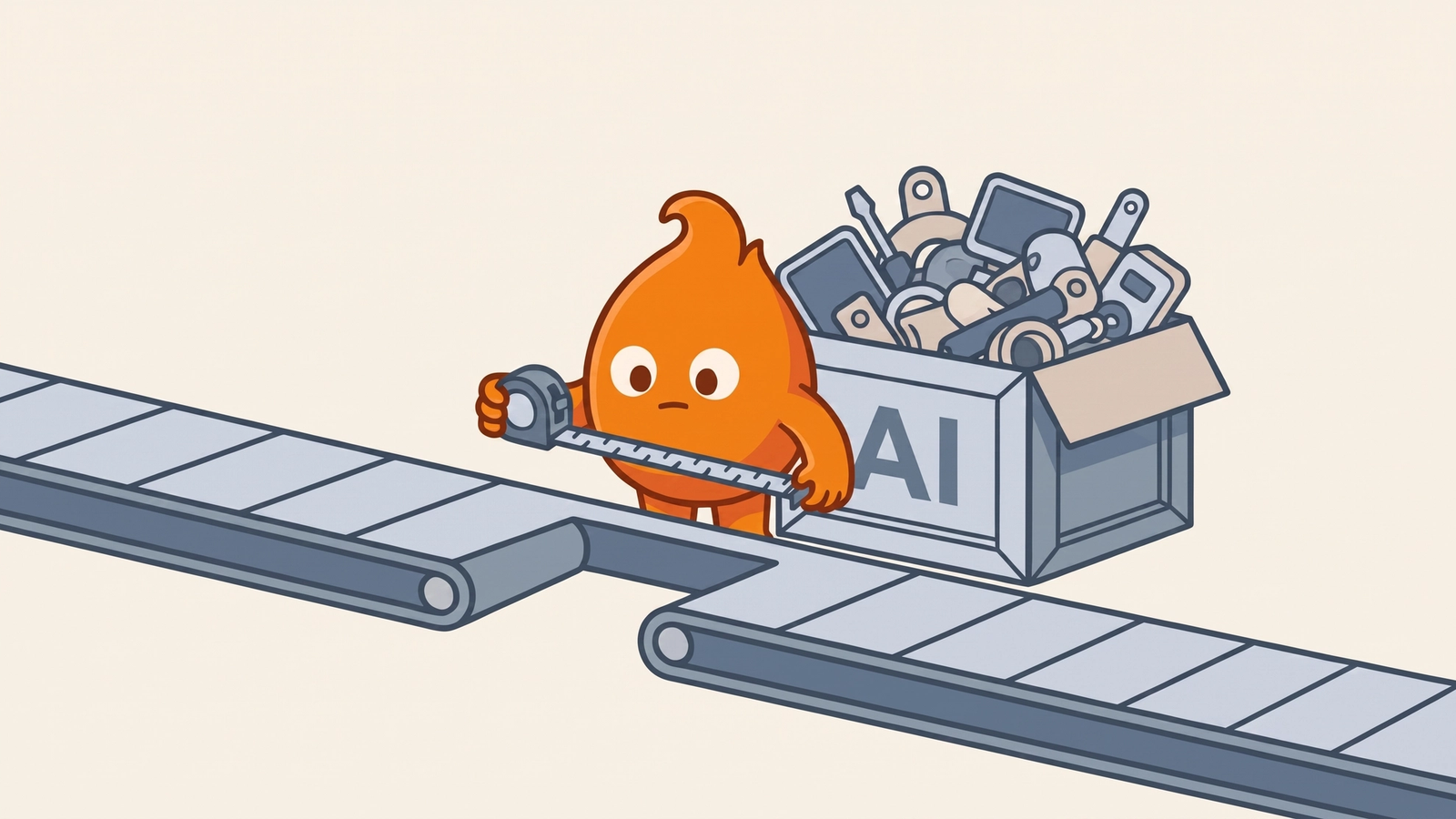
The AI feature shipped on time. The demo impressed the board. The usage dashboard has been flat since launch.
Why aren't customers using it? Usually because the feature started from what the model can do, not from a task a specific user is stuck on. A shipped feature nobody uses is the same failure as a stalled pilot, with better branding. The fix is workflow work, not more model.
The pattern now has a number. On July 28, 2026, Banyan Software published The State of AI for Vertical Market Operators, a survey of more than 260 founders, CEOs, and operators of vertical market software companies. Its headline finding: "51% of software operators see fewer than one in four customers actually use the AI they built." Banyan's own summary: "Deployment, not development, is the industry's biggest AI challenge." In IT Brew's coverage of the survey, Banyan's president of M&A, Max Risen, described companies "building for the sake of building and not necessarily building to solve specific problems."
Is an unused AI feature a failed launch?
In business terms, yes. Feature adoption is the share of customers who use a feature in their regular work. A feature that runs in production and changes nobody's workday has the same value as a pilot that never shipped, minus the inference bill you now pay to keep it idle.
The industry treats the pilot-to-production gap as the finish line. The Banyan numbers say otherwise. These features passed engineering, QA, and release. They run in production. Customers still don't touch them.
That removes the usual excuses. The problem was not model quality, infrastructure, or compliance review. The feature works. It answers a question nobody asked. Production was never the finish line. Adoption is.
The question that got skipped
Every unused AI feature we have been asked to look at skipped the same first question: which specific user, in which specific workflow, is stuck today, and what would remove the obstacle?
Teams answered a different question: what can the model do? That question produces plausible features fast, which is the trap. A feature idea used to cost weeks of due diligence before anyone built it. Now a team can ship something before anyone confirms a customer needs it. The cost of building dropped. The cost of building the wrong thing did not.
How to get customers to use an AI feature
Adoption comes from four pieces of work, and most teams budget only for the build.
Start from an observed workflow, not a capability list. Watch what users do the slow way today. The AI feature that gets used replaces a task someone already does and resents.
Name the user who is stuck. A feature for everyone is a feature for nobody. The unused features we review are mostly broad: summarize this, chat with that. The used ones compress one painful step for one identifiable role.
Measure usage from day one, and treat silence as a defect. A flat dashboard three weeks after launch is a finding. Something in the workflow assumption was wrong. Diagnose it the way you would diagnose a failed deployment.
Budget for the workflow change, not only the build. Getting a feature into daily use takes onboarding and retraining. Sometimes it also changes how a task moves between people. That work is unglamorous, and it is where adoption happens.
The uncomfortable symmetry
Buyers now judge AI consultancies by whether their work ships. The Banyan data says to ask a harder question: does it get used? Shipping is necessary and it settles nothing.
An ignored feature needs the same discipline that rescues a stalled pilot: find the binding constraint in a real workflow and remove it. Our guide to running an AI pilot that doesn't waste the budget starts from the same place. Running that diagnosis on a feature already in production is what our AI implementation framework is for. AI that ships, not AI that demos. And once it ships, AI that gets used.