
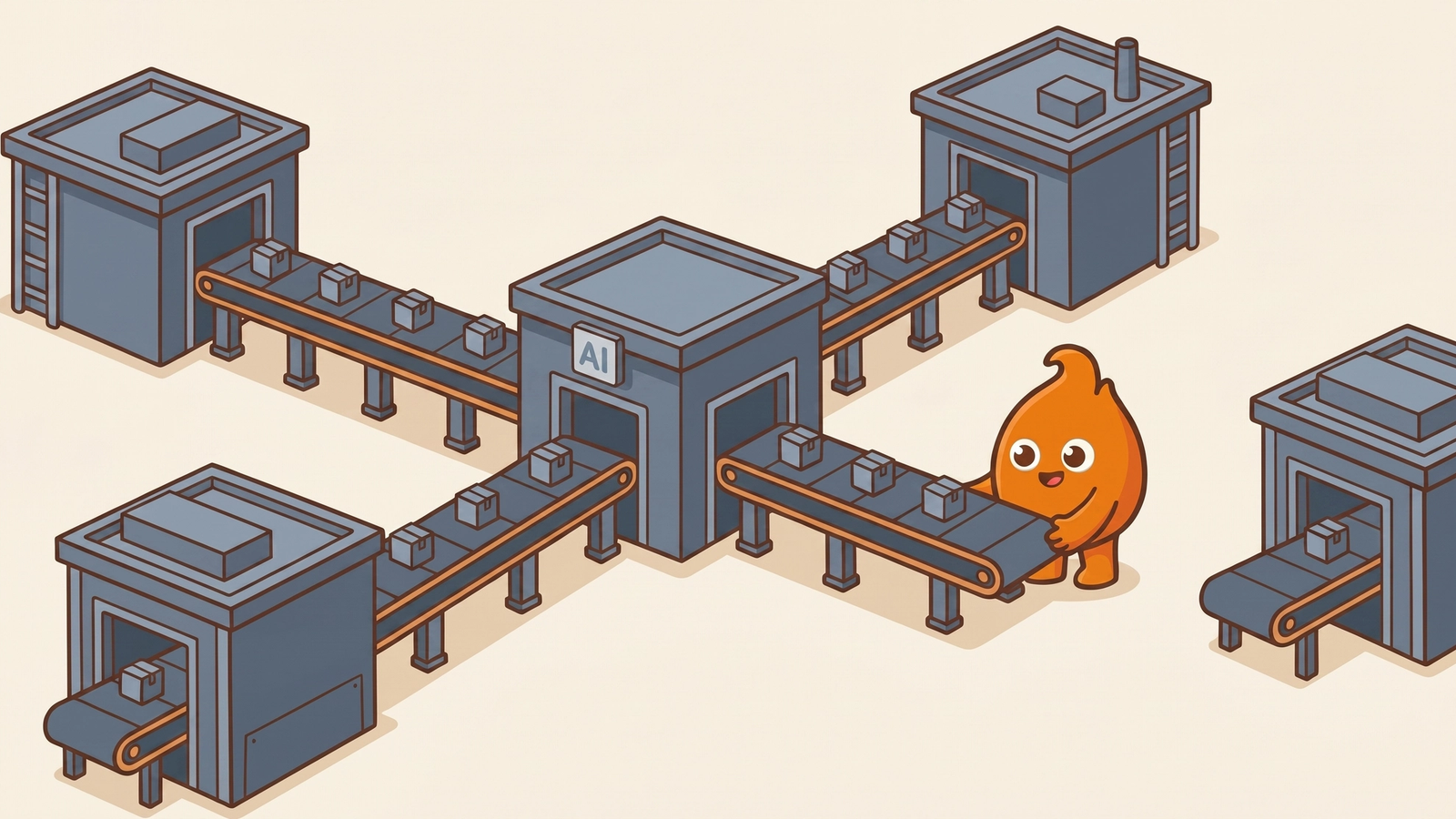
On July 1, 2026, Gartner projected that up to $234 billion of enterprise application spending is exposed to "agentic arbitrage" between now and 2030. That number will end up in a lot of board decks. Before it shapes your roadmap, read what it assumes.
The short answer: agentic arbitrage pays off only for companies whose systems an agent can reach, act on, and remember. For most mid-market companies, that is integration and modernization work, not a platform purchase.
What is agentic arbitrage?
Agentic arbitrage is the spending that shifts when AI agents complete tasks across several systems that a person used to click through by hand. Gartner's press release on agentic arbitrage defines it that way and sizes it at roughly 20 percent of enterprise application SaaS spending by 2030. When an agent does the clicking, the seat license, the interface, and the dashboard matter less. Gartner calls the result "less an apocalypse and more of a metamorphosis."
The same release carries two sentences that get quoted less often. Vendors already delivering these outcomes "typically" require "heavy services engagement." And "better outcomes from AI require systems that can retain deep institutional memory and customer context over time." Those two sentences are the whole readiness question.
Agentic arbitrage is an integration problem first
The value does not come from the model being clever. It comes from the agent reaching each system, reading current state, taking an action, and confirming the result without a person checking each hop.
Take an agent that drafts a renewal in your CRM, checks entitlement in your billing platform, and updates the support ticket. It is useful only if it can authenticate to all three systems. The data it reads has to be current. A failure at step two cannot leave step one half-committed. None of that is a model capability. It is the systems-integration discipline that has always separated software that works from software that demos.
Retained context is the harder half
An agent that forgets what happened a month ago is a chatbot with API access. The workflows worth automating depend on context the agent carries forward: what this customer already asked for, which exceptions your team approved before, who actually signs off.
Holding that context is engineering, not a prompt you write once. Anthropic's guide to context engineering for AI agents calls context "a critical but finite resource" and notes that accuracy declines as the token count grows. Its answer for long-running work is machinery: compaction, notes the agent keeps outside the context window, and retrieval that loads the right record at the moment it is needed. We cover the harness side in why long-running AI agents fail. If a vendor treats retained context as a feature that is already handled, probe that claim first.
Why older systems are the most exposed
The companies most exposed to agentic arbitrage are often the least able to capture it. Arbitrage rewards clean, reachable systems, and a 20-year-old line-of-business app is rarely either.
An agent cannot work across an application with no real API, a data model that lives in one developer's head, or authentication through a shared service account nobody wants to touch. A legacy ColdFusion app can take part in an agentic workflow. First it needs a reachable interface, a clear contract for reading and writing state, and scoped access that lets an agent act without becoming your largest security hole. That is remediation, and it comes before the agent. We make the full case in fix the foundation before you bolt on the agent.
What to do with the $234 billion number
Treat the forecast as a reason to run an inventory, not a reason to buy a platform. Three questions separate a real candidate from a slide.
Which workflows already cross two or more systems? Those are your arbitrage candidates. A workflow that lives inside one application has nothing to arbitrage yet.
Can an agent reach every system in the chain? It needs a real interface and scoped, auditable access. Screen-scraping or a god-mode service account means integration and security work comes first.
Where does the context live? If the answer is "in the heads of two senior people," the agent will be confidently wrong until someone writes that knowledge down where a system can read it.
In practice, we test the second question by building the orchestration layer first, often in n8n, with its own scoped credentials for each system and a log of every hop. If that layer cannot be built without a shared admin account, the agent is not ready either. Answering all three questions is the substance of an AI readiness assessment. Workflows that pass go into an AI implementation plan. Workflows that fail become a modernization backlog with an AI business case attached, which is a better reason to fund that work than most older systems have had in years.
Gartner's number is a forecast. Whether it lands in your favor is an engineering decision you can make now.