
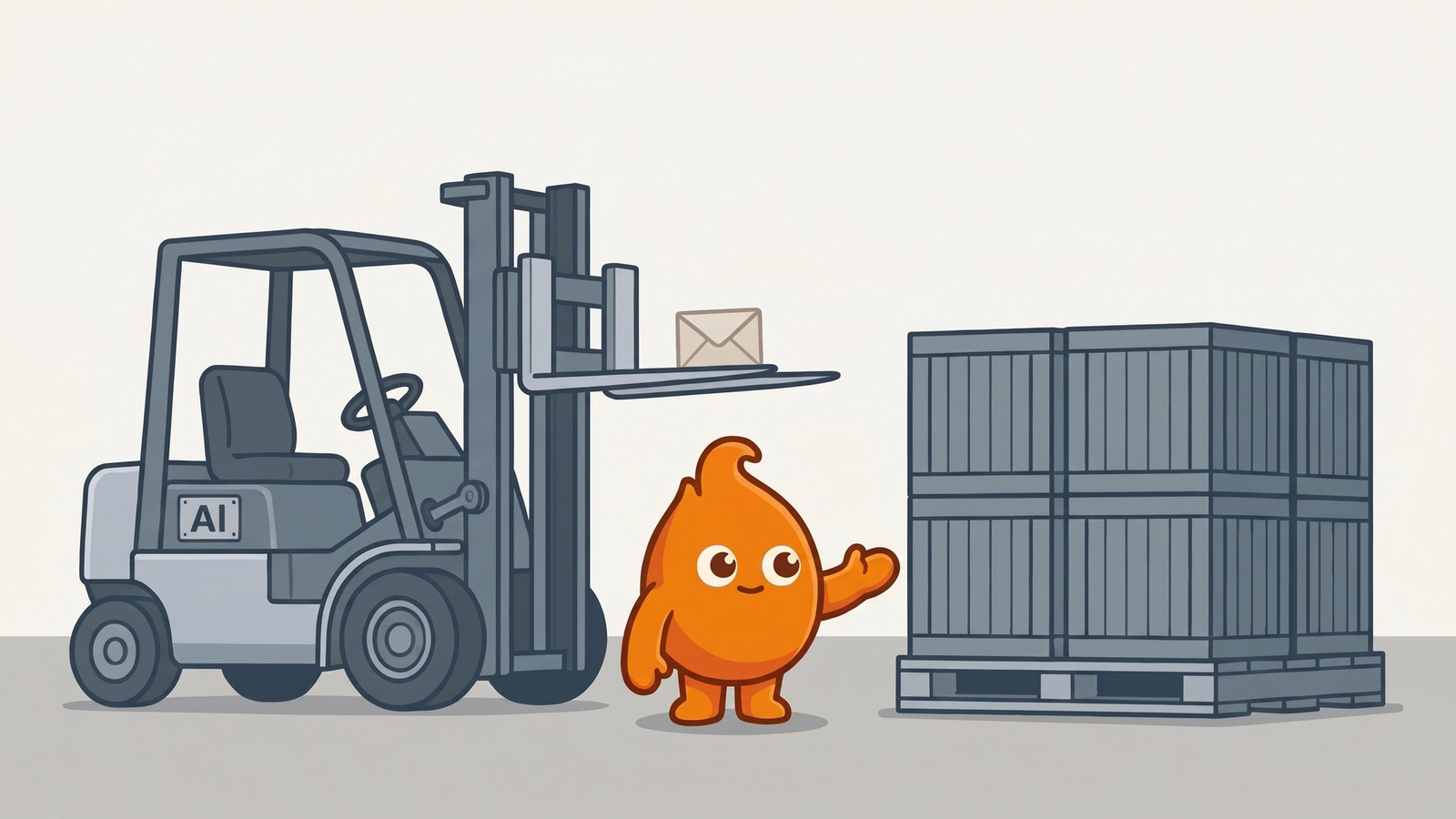
Here is the scenario. The enterprise license is signed and every seat is provisioned. Six months later, most of what people send the model is a question they could have typed into a search engine, followed by a request to summarize the answer.
When a mid-market company asks why its enterprise AI license has not changed how work gets done, this is usually what sits underneath. The capability is there. The organization uses a small slice of it, and the slice it uses is the part that was already cheap. What closes the gap is not a better model. It is scoping, review, and authority.
In a September 18, 2026 essay, Ethan Mollick calls this the capability overhang: the gap between what current models can do and what almost anyone is doing with them. He comes at it from the adoption side. We come at it from delivery, because we build and run production agentic pipelines and see where the gap opens inside working teams. None of what closes it is a prompting trick.
The search-box habit is a scoping failure
A model used as a search box gets asked questions. A model used as a delegate gets handed work. The difference is not the model's ceiling. It is what the organization was willing to define.
A question costs nothing to scope. Handing over work means someone has to say what done looks like, what the agent may touch, and who checks the result. When nobody owns that definition, the tool stays in the one mode that needs none, and the license pays for a very expensive autocomplete.
Anthropic's June 2026 analysis of roughly 400,000 Claude Code sessions shows why the definition matters. In a typical session, people made about 70 percent of the planning decisions and the agent made about 80 percent of the execution decisions. The more domain expertise a person brought, the more work the agent did per instruction. Read that from the buyer's side. Output scales with how well someone can specify the problem, and a vague ask gets a vague fraction of what you are paying for.
How to get real work out of an enterprise AI license
Teams that get real work out of an AI license share three habits: specific asks with an acceptance test, staffed review, and real authority behind gates.
Specific asks with an acceptance test. Teams that get value hand the agent a bounded piece of real work and say how it will be judged: this endpoint, these tests pass, this migration verified against this dataset. Teams that do not get value ask the agent to help with something. The model cannot supply specificity the organization never wrote down.
Review that is staffed. Delegated work needs a reader who applies the rigor they would give a contractor's pull request. Skip that and one of two things happens. The output ships unreviewed and eventually embarrasses someone, or a senior engineer quietly redoes it and the tool takes the blame. Review is what makes delegation safe at volume, and AI coding has already moved the bottleneck to code review, so review needs real capacity, not the spare minutes at the end of someone's day.
Real authority, behind gates. An agent that can read but never act is a search box with extra steps. The value shows up when the agent can run the tests, open the pull request, and execute the data job. It then stops at defined moments: anything that leaves the building, anything irreversible, anything that spends money. Teams that never grant authority never learn what the model can do. Teams that grant it without gates learn the hard way.
What the overhang looks like from the delivery side
From the delivery side, the capability overhang is work a team already does the slow way but has never described precisely enough to delegate. When we start work with a team, the first conversation is rarely about the model. It is about finding that work. That list starts short. It grows as people learn to write acceptance tests for their own work, and it grows faster once the first delegated task ships and the skeptics see a reviewed result instead of a demo.
Mollick names four human advantages that shape how much a person gets out of AI: deep knowledge, wide knowledge, taste, and agency. They map onto the three habits. Deep knowledge writes the acceptance test. Taste does the review. Agency, which Mollick describes as testing the boundaries yourself instead of waiting for someone to tell you what the tools can do, is what gets the first real task handed over. Organizations sitting on an overhang are not short of models. They are short of people who have permission, and a process, to use those models as delegates.
The uncomfortable version
If your AI spend has not changed a single workflow's cycle time, the model is probably not the constraint. Scoping, review capacity, and authority are. Each one is an organizational decision, and each one costs less than the license you already pay for.
Finding which one binds first is the diagnostic our AI implementation framework starts with, before anyone touches a prompt. AI that ships, not AI that demos.