
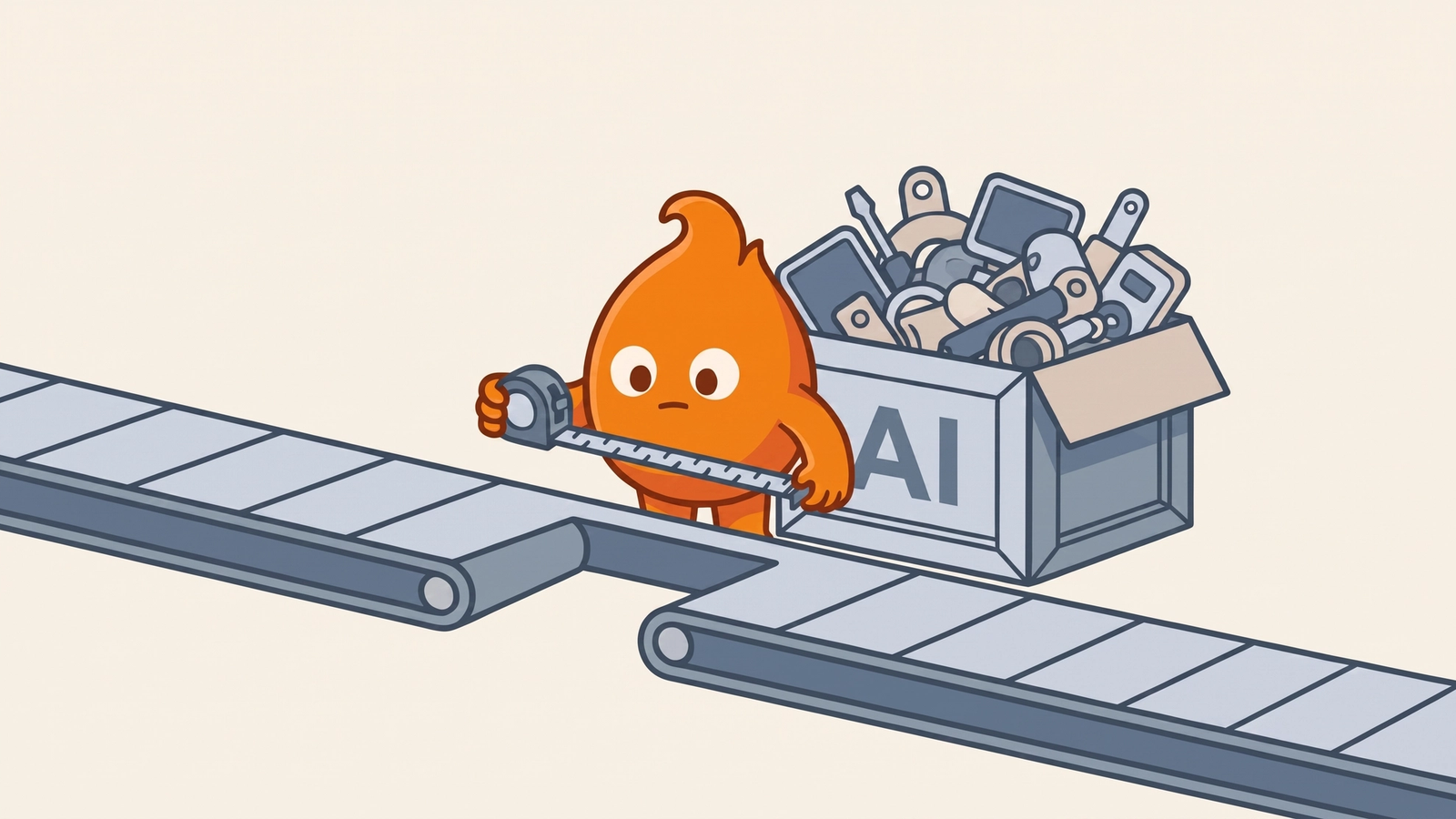
The AI feature shipped on time. The demo impressed the board. The usage dashboard has been flat since launch.
That pattern is now measured. Banyan Software surveyed more than 260 founders and CEOs of vertical-market software companies, and 51% reported that fewer than one in four customers use the AI capabilities that shipped with their product. Banyan's president of M&A attributes it to companies building for the sake of building. We would say it more plainly: a shipped feature nobody uses is the same failure as a stalled pilot. It just has better branding.
We build production AI systems for mid-market companies, and the post-launch silence around an unused feature has the same root cause as the pilot that never leaves the demo stage. The work started from the capability, not from the workflow.
A shipped feature can still be a stalled pilot
The industry talks about the pilot-to-production gap as if crossing it were the finish line. The Banyan numbers say otherwise. These features made it through engineering, QA, and release. They are in production. Customers still do not touch them.
That is worth sitting with, because it removes the usual excuses. The problem was not model quality, infrastructure, or compliance review. The feature works. It answers a question nobody was asking.
Production was never the finish line. Adoption is. A feature that runs in production and changes nobody's workday has the same business value as a pilot that never shipped, minus the inference bill you now pay to keep it idle.
The question that got skipped
Every unused AI feature we have been asked to look at skipped the same question at the start: which specific user, in which specific workflow, is stuck today, and what would remove that obstacle?
Teams answered a different question instead: what can the model do? That question generates plausible features at a remarkable rate, which is exactly the trap. Generating a feature idea used to cost weeks of due diligence. Now a team can ship something new before anyone has confirmed a customer needs it. The cost of building dropped. The cost of building the wrong thing did not.
What adoption work actually looks like
Start from an observed workflow, not a capability list. Watch what users do the slow way today. The AI feature that gets used replaces a task someone already performs and resents.
Name the user who is stuck. A feature for everyone is a feature for nobody. The unused features in the Banyan cohort were mostly broad: summarize this, chat with that. The used ones tend to compress one painful step for one identifiable role.
Measure usage from day one, and treat silence as a defect. A flat dashboard three weeks after launch is a finding, not a disappointment. Something about the workflow assumption was wrong. Diagnose it the way you would a failed deployment.
Budget for the workflow change, not just the build. Getting a feature into a customer's hands takes onboarding, retraining, and sometimes renegotiating how a task flows between people. That work is unglamorous and it is where adoption actually happens.
The uncomfortable symmetry
Companies now evaluate AI consultancies by asking whether their work ships. The Banyan data says buyers should ask a harder question: does it get used? Shipping is necessary and it settles nothing.
If you have an AI feature in production that customers ignore, the fix is rarely more model. It is the same discipline that rescues a stalled pilot: find the binding constraint in a real workflow and remove it. That diagnostic is what our AI implementation framework exists to run. AI that ships, not AI that demos. And once it ships, AI that gets used.