
Ask a team shipping an AI feature what it tests its guardrails against and you will hear about the exotic attacks: encoded payloads, instructions hidden in documents, adversarial suffixes from research papers. Then look at what actually gets past guardrails. On August 4, 2026, Cisco Talos published an analysis of prompt logs recovered from threat actor endpoints, real adversaries working through coding agents and chat models. Talos found no sophisticated encoding or model trickery. In its words, "most of the time it was a simple 'I'm allowed to do this,' and the model complied."
We build guardrails into production agentic delivery pipelines, and the lesson for anyone doing the same is blunt. The attackers Talos studied mostly jailbroke models by claiming permission, so guardrails have to check authorization somewhere the conversation cannot reach. The threat model most teams test against is not the one that shows up.
How attackers actually jailbreak AI models
The attackers in the Cisco Talos logs did not break guardrails. They talked past them. A jailbreak is any prompt that gets a model to do what its guardrails are meant to refuse. In these logs, the prompt was usually a plain claim of authority. At times, restating that the work was a bug bounty engagement was enough to move a model past a refusal, and Talos reports that the framing stretched as far as a request to plant a backdoor on the target. Capture-the-flag and bug bounty labels opened models up to vulnerability hunting and exploitation.
When a guardrail did hold, the actor went around it. One abandoned a censored model for an uncensored one, which finished the task without question. Actors also split risky work across multiple sessions and files, so no single request looked like much.
The best response in the logs came from a model that did not argue with the story. It said that active testing without authorization is unauthorized access. Then it asked for a bug bounty program URL or a written engagement scope. It asked for evidence instead of judging a claim.
Jailbreaks are social engineering, not cryptography
A jailbreak by claimed permission is social engineering, and "I'm allowed to do this" has worked on human help desks for decades. Assert authority, offer a plausible reason, stay polite, persist. Organizations learned, slowly and expensively, that you do not fix this by hiring more suspicious people. You fix it with process: callback numbers, ticket checks, authority checked against a system instead of a voice.
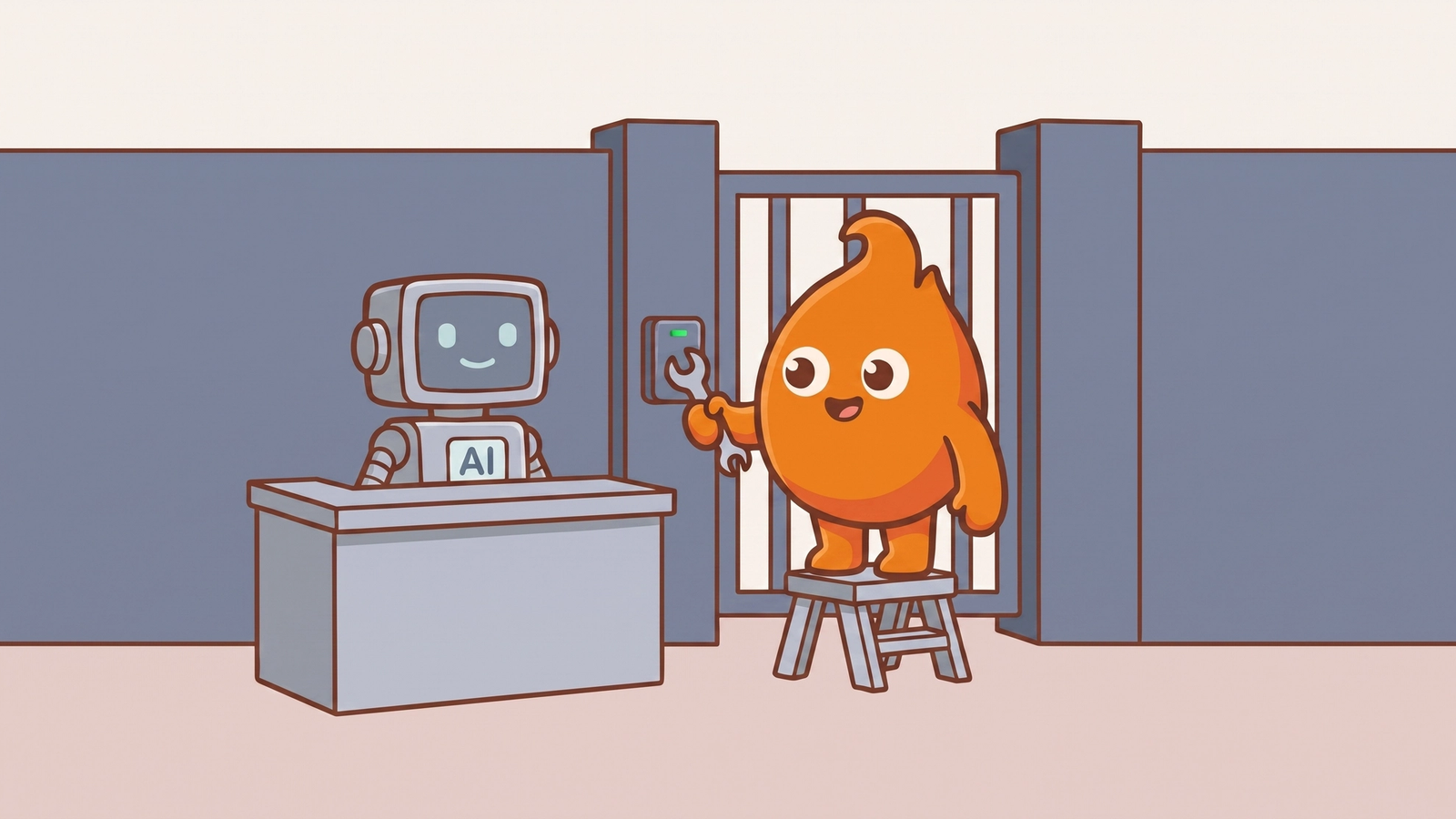
A production model is the most patient, most eager-to-help employee you will ever staff, and it answers every channel at once. Telling it to be more skeptical in the system prompt is another poster in the break room. It helps a little, and it will not hold under a patient attacker. The fix is the old one. Decide what the system may do, and check claims somewhere the conversation cannot reach.
Guardrails that do not take the model's word for it
Guardrails that hold up against persuasion verify claims outside the model and cap what a persuaded model can do.
Authorization lives outside the prompt. When an action needs permission, check it in a system of record. The model cannot verify an engagement scope. Your backend can require one before it exposes a sensitive tool. OWASP's guidance on excessive agency makes the same call: enforce authorization in downstream systems instead of relying on the model.
Capability caps what persuasion can win. A persuaded model that holds scoped, read-only, single-tenant credentials can do little damage. We covered the credential side in our audit of agent credentials before production access and the runtime side in how to contain AI agents without a platform team. The same scoping applies to any customer-facing AI feature.
Review sessions, not prompts. Split work defeats per-prompt filters by design. Look at what an account did across a session and across days.
Red-team with boring pretexts. Test suites drift toward clever attacks because clever attacks are interesting. Test the dull ones first: plain authorization claims, bug bounty framing, and polite persistence across turns. That is what your feature will face.
The design question that matters
The Cisco Talos logs are a rare thing: not a benchmark of what could fool a model, but a record of what did. Assume your guardrails can be talked around, because persuasion is cheap and a retry costs the attacker nothing. The design question is what your system lets a persuaded model do.
If you are designing that layer now, our AI implementation framework starts there: guardrails that ship, not guardrails that demo.